






















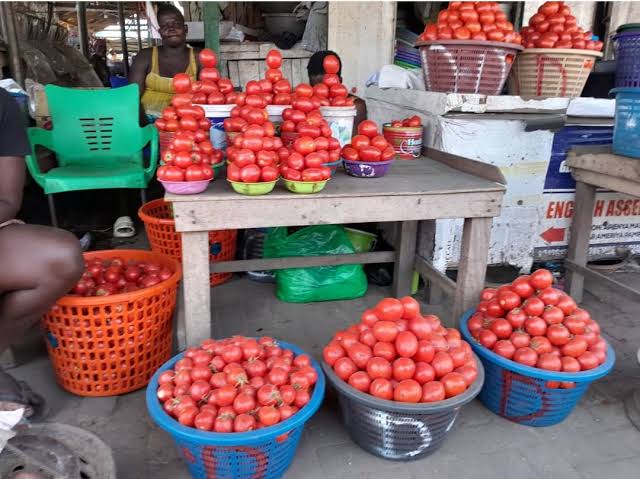
Ghana is spending about US$168 million every year on fresh and processed tomato imports, while a disease outbreak has left the country importing more than 99 per cent of its ginger requirements, researchers at the Council for Scientific and Industrial Research (CSIR) have disclosed.
The figures have renewed concerns about Ghana’s dependence on imported agricultural commodities despite the country’s significant potential for local production.
The researchers presented the data during the second session of the 2026 Ministry of Environment, Science, Technology and Innovation (MEST) Visibility Webinar Series, held under the theme, “CSIR’s Interventions on Tomato and Ginger.”
Ghana produces less than a fifth of its tomato requirement
Dr Michael Kwabena Osei, a Principal Research Scientist and vegetable breeder at the CSIR Crop Research Institute, said Ghana’s annual demand for fresh and processed tomatoes is estimated at more than 1.4 million metric tonnes.
Local farmers, however, produce only about 15 to 18 per cent of the country’s requirement.
The resulting supply gap is largely filled through imports.
Ghana imports an estimated 100,000 to 120,000 tonnes of fresh tomatoes annually, mainly from Burkina Faso. These imports cost the country approximately US$18 million each year.
The country also imports processed tomato products, largely from China and Europe. These products are equivalent to an estimated 400,000 to 450,000 tonnes of raw tomatoes and cost approximately US$150 million annually.
Combined, Ghana’s annual expenditure on fresh and processed tomato imports is therefore estimated at US$168 million.
Dry season increases import dependence
The tomato import challenge is particularly pronounced during the dry season.
More than 60 per cent of fresh tomato imports enter Ghana between November and April, when domestic production declines significantly.
Dr Osei said the situation reflects a major production gap that could potentially be addressed through improved farming systems.
Ghana has more than 400,000 hectares of arable land considered suitable for tomato cultivation. However, average yields remain between seven and 10 tonnes per hectare.
With improved varieties and better farming practices, yields could potentially reach between 20 and 80 tonnes per hectare, according to the researchers.
Why tomato production remains low
The researchers identified several factors limiting Ghana’s tomato production capacity.
These include inadequate access to quality seed, limited irrigation facilities, declining soil fertility, pests and diseases, and inadequate extension services.
The country’s dependence on imported planting material is also a concern.
Dr Osei said more than 85 per cent of tomato seeds planted in Ghana are commercial hybrid varieties, which can increase production costs for farmers while creating exposure to external seed supply constraints.
He summarised the concern by saying: “A country that imports its seed will always import its food.”
Irrigation infrastructure remains underused
Limited access to reliable water is another major obstacle to year-round tomato production.
According to the researchers, Ghana has 22 public irrigation schemes covering about 15,000 hectares, but only approximately 9,000 hectares are currently being utilised.
Improving the use of existing irrigation infrastructure, they argue, could help reduce the seasonal fluctuations that contribute to Ghana’s dependence on imported tomatoes.
Ginger production suffers major setback
The situation in the ginger sector has been compounded by disease.
Dr Osei said Ghana’s annual ginger requirement increased from approximately 18,000 tonnes in 2020 to between 30,000 and 32,000 tonnes in 2025.
However, domestic production suffered a major setback following a bacterial wilt outbreak in 2022.
The disease has since pushed Ghana’s dependence on imported ginger to more than 99 per cent, with the country spending approximately US$500,000 annually on ginger imports from countries including China, Nigeria and Burkina Faso.
Ginger prices surge
The collapse in local production has also contributed to a sharp increase in ginger prices.
A sack of ginger that sold for around GH¢250 in 2022 reportedly rose to approximately GH¢4,000 in 2025.
By the time of the CSIR webinar, the price had climbed to about GH¢6,000 or more, highlighting the impact of the production shortage on consumers and businesses.
CSIR proposes disease-control measures
Researchers say the bacterial wilt affecting ginger is soil-borne and can spread through infected planting materials and contaminated farm equipment.
Poor drainage, excessive rainfall and continuous cultivation of the same crop can also contribute to the spread of the disease.
To revive Ghana’s ginger industry, the CSIR is proposing measures including the development and distribution of disease-resistant varieties, the production of disease-free planting materials through tissue culture, stronger disease surveillance and improved extension services for farmers.
CSIR pushes broader agricultural reforms
The tomato and ginger challenges, according to the researchers, demonstrate the need for stronger investment across Ghana’s agricultural value chains.
Proposed interventions include greater investment in certified seed production, irrigation, soil improvement, mechanisation and protected cultivation.
Dr Osei has also proposed the establishment of a Tomato Board by 2028 and a dedicated Horticultural Research Institute by 2030.
Such institutions, he argues, could help coordinate research, seed development, financing, processing and market integration within the horticultural sector.
For Ghana, reducing dependence on imported tomatoes and ginger would go beyond lowering food import bills. It could create opportunities for farmers and processors, strengthen domestic value chains and retain more foreign exchange within the economy.
The CSIR researchers therefore believe that closing the production gap will require sustained investment in agricultural research and infrastructure, alongside stronger support for farmers to adopt improved technologies and production practices.