






















The military confrontation between the United States and Iran has intensified, with both countries carrying out fresh attacks that underscore the collapse of their recent ceasefire and raise concerns about wider instability across the Middle East.
On Saturday night, the United States launched another round of airstrikes targeting Iranian military infrastructure, while Iran responded by claiming responsibility for drone attacks against two American military facilities in Kuwait.
US Targets Iranian Military Infrastructure
According to the US Central Command (CENTCOM), American forces struck Iranian coastal surveillance systems, air defence installations and facilities linked to the Islamic Revolutionary Guard Corps (IRGC).
The operation was described as part of efforts to weaken Iran’s ability to threaten commercial shipping through the Strait of Hormuz, one of the world’s most strategically important maritime trade routes.
CENTCOM also said the strikes were intended to retaliate against IRGC forces it blamed for a missile and drone attack in Jordan on Friday that killed two US service members and left another missing.
Iranian state media reported that Qeshm Island, located near the Strait of Hormuz, was among the areas hit during the latest wave of US attacks.
Iran Launches Retaliatory Drone Strikes
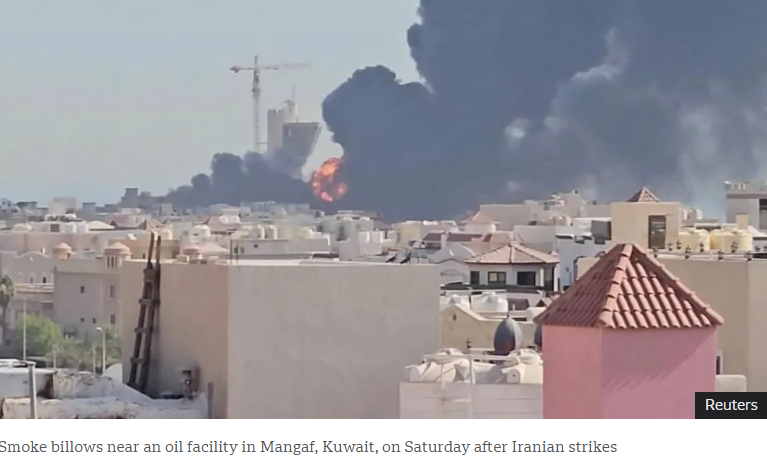
Iran’s military later announced that it had carried out retaliatory drone attacks on two US military installations in Kuwait.
According to the IRGC-affiliated Tasnim News Agency, the operations targeted Camp Udairi and Ali Al Salem Air Base using what it described as large-scale kamikaze drone attacks.
The reported strikes mark another significant escalation in the conflict, which has seen both countries exchange attacks on military assets and strategic infrastructure over the past week.
Ceasefire Breakdown Fuels Renewed Conflict
The latest military exchanges come after a preliminary ceasefire agreement reached in June collapsed earlier this month.
Relations deteriorated following Washington’s decision to reimpose its blockade of Iranian ports, while Tehran responded by declaring the Strait of Hormuz closed to shipping.
US President Donald Trump subsequently declared the ceasefire agreement “over” on July 8, paving the way for renewed military operations.
Casualties Continue to Rise
Earlier on Saturday, CENTCOM confirmed that two American service members were killed while defending against Iranian missile and drone attacks in Jordan. One additional service member remains missing.
US Defence Secretary Pete Hegseth paid tribute to the fallen troops, describing their sacrifice as strengthening America’s resolve.
The deaths bring the reported US military fatalities in the conflict to 16 after an American Navy pilot who had been missing earlier this month was officially declared dead.
Iran has also reported mounting casualties. According to the country’s Health Ministry, at least 50 people have been killed and more than 500 injured during US airstrikes over the past three weeks.
Dispute Over Civilian Infrastructure
The latest escalation has also been accompanied by competing claims over attacks on civilian infrastructure.
Iran has accused the United States of striking bridges and transportation facilities, allegations Washington has denied, insisting its operations have been directed exclusively at military targets and logistics infrastructure.
Meanwhile, the Gulf Cooperation Council accused Iran of attacking civilian facilities after Kuwaiti authorities reported damage to a power plant and a water desalination facility following the drone attacks.
Under international humanitarian law, deliberate attacks on civilians and civilian infrastructure are prohibited. However, facilities normally considered civilian may become lawful military targets if they are being used to support military operations.
Diplomatic Relations Continue to Deteriorate
The renewed fighting has further diminished hopes for restoring diplomatic engagement between Washington and Tehran.
Late on Saturday, Iran’s Supreme Leader, Mojtaba Khamenei, accused the United States of repeatedly violating the ceasefire agreement, arguing that Washington’s actions had undermined confidence in any future commitments.
His remarks reflect the widening diplomatic divide as both countries continue to exchange military strikes with no immediate signs of de-escalation.
The latest developments have heightened concerns among regional and international observers that continued retaliation by both sides could further destabilise the Middle East and disrupt global trade routes, particularly through the Strait of Hormuz.