
























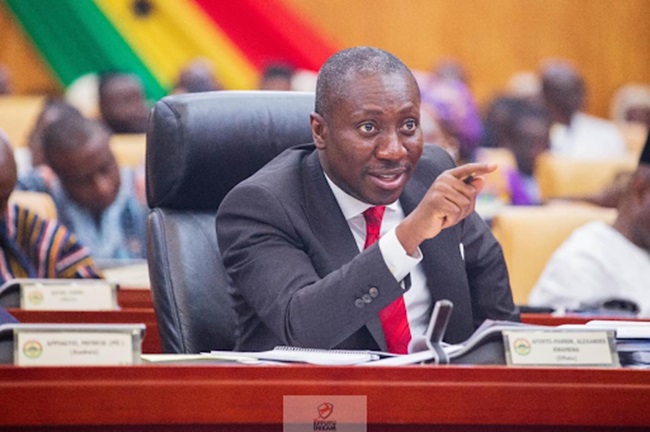
Minority Leader Alexander Afenyo-Markin has accused the National Democratic Congress (NDC) government of adopting a position on Supreme Court appointments that contradicts the stance it maintained while in opposition.
The comments follow President John Dramani Mahama’s nomination of three new justices to the Supreme Court, a move that, if approved by Parliament, will increase the number of judges on the country’s apex court from 18 to 21.
The nominees are Court of Appeal Justices Sophia Rosetta Bernasko Essah and Edward Amoako Asante, alongside private legal practitioner Tony Forson. The nominations were made by President Mahama in consultation with the Judicial Council in accordance with Article 144(2) of the 1992 Constitution.
The government has explained that the appointments are aimed at strengthening the capacity of the Supreme Court to handle its increasing workload, reduce case backlogs and improve the efficiency of justice delivery.
However, speaking on the development, Mr Afenyo-Markin questioned the consistency of the NDC’s position on judicial appointments, arguing that the party had previously opposed similar attempts to increase the number of Supreme Court judges under the former New Patriotic Party (NPP) administration.
He said the issue was not about the competence or qualifications of the nominees, but rather about the principles surrounding the expansion of the court.
The Minority Leader pointed to debates in 2024 when the then-Chief Justice, Gertrude Torkornoo, requested the appointment of additional Supreme Court judges to address workload concerns.
At the time, senior NDC officials criticised the proposal, raising concerns that increasing the size of the Supreme Court could affect public confidence in the independence of the judiciary.
Mr Afenyo-Markin argued that the NDC’s decision to proceed with similar appointments after returning to power represents a departure from the position it defended while in opposition.
While the Minority maintains that the appointments raise concerns about consistency and institutional independence, the government has maintained that the nominations are within the President’s constitutional mandate and are intended to strengthen the judiciary.
Parliament is expected to consider the nominations through the Appointments Committee before a final decision is reached by the House.
`








 government of adopting a position on Supreme Court appointments)