






















Association of Ghana Industries (AGI) has raised fresh concerns about the impact of persistent power disruptions on Ghana’s manufacturing sector, warning that unreliable electricity supply is increasingly becoming a major obstacle to industrial growth and competitiveness.
According to the Association, energy challenges have evolved beyond operational cost concerns and now represent a structural constraint affecting production levels, investment confidence and the long-term sustainability of businesses within the industrial sector.
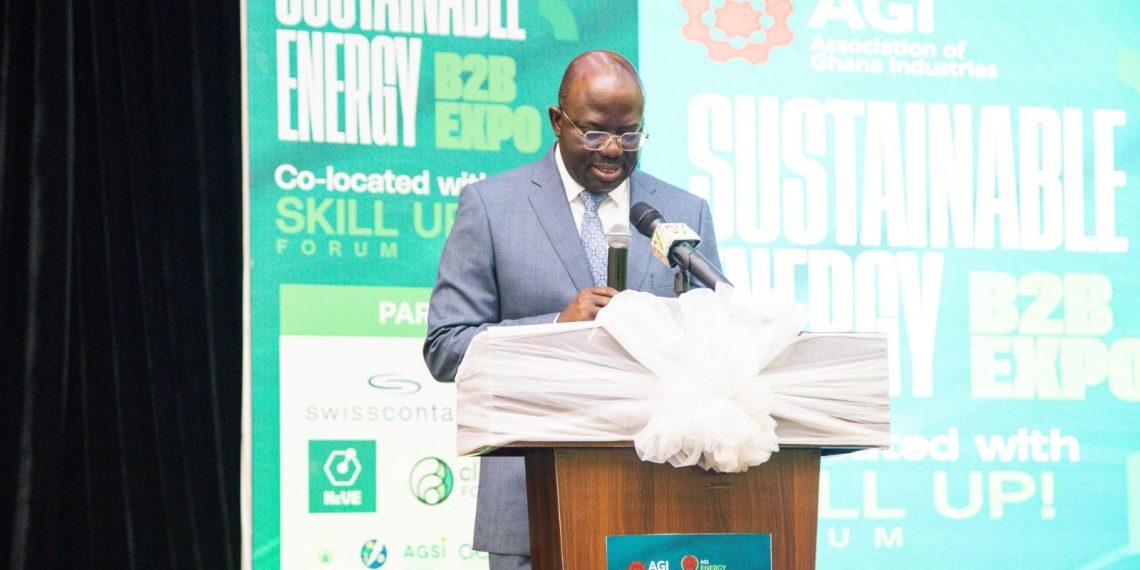
Speaking at the Sustainable Energy B2B Expo 2026, held under the theme “Powering Industry through Sustainable Energy,” AGI President Dr Pharm. Kofi Nsiah-Poku said the recent power disruptions have exposed vulnerabilities within Ghana’s production systems and highlighted the urgent need for reforms in the country’s energy architecture.
He explained that industries are already operating under difficult conditions due to rising production costs, global competition and increasing sustainability demands, making a reliable and affordable power supply critical for business survival and expansion.
“Energy remains the lifeblood of industrial growth. Without reliable, affordable and sustainable power, industries cannot expand, and businesses cannot compete effectively,” he stated.
Dr Nsiah-Poku further warned that Ghana’s broader industrialisation agenda, including plans to implement a 24-hour economy, could be undermined if a stable electricity supply is not guaranteed.
“Ghana’s ambition of building a strong industrial economy and sustaining a 24-hour economy cannot be achieved without a stable and uninterrupted power supply,” he added.
He also argued that sustainable energy should no longer be treated as a peripheral issue in national development discussions, insisting that it must become a central component of Ghana’s industrial strategy.
“Sustainable energy can no longer be treated as an alternative discussion on the sidelines of development. It must become central to our industrial strategy,” he stressed.
As part of efforts to support businesses through the energy transition, Dr Nsiah-Poku highlighted AGI’s Energy Service Centre, which provides firms with energy efficiency support and renewable energy integration solutions.
According to him, the initiative demonstrates AGI’s commitment to helping industries balance sustainability goals with profitability.
“It represents AGI’s commitment to helping industries transition into a future where sustainability and profitability work hand in hand,” he noted.
Also addressing participants at the Expo, Gunnar Wegner, described the global energy transition as a competitiveness issue rather than simply an environmental concern.
He compared investment in renewable energy to “moving into your own house,” explaining that businesses that adopt renewable energy solutions are better protected from fuel price volatility and external cost shocks.
Mr Wegner stated that investments in renewable energy and energy efficiency offer long-term financial savings while helping companies meet sustainability expectations in international markets. He added that the private sector would play a central role in driving Ghana’s energy transition.
The Expo brought together several development partners and industry stakeholders, including GIZ, Swisscontact, UN Global Compact Network Ghana, ClimateWorks Foundation, Catalonia Trade & Investment, AHK Ghana and the Energy Commission.
Participants engaged in exhibitions, networking sessions and innovation discussions aimed at connecting businesses with sustainable energy solutions. Stakeholders also emphasised the need for stronger collaboration, financing mechanisms, innovation and supportive policies to accelerate the transition toward cleaner and more efficient industrial energy systems in Ghana.
By: Janice Opoku-Agyemang