
















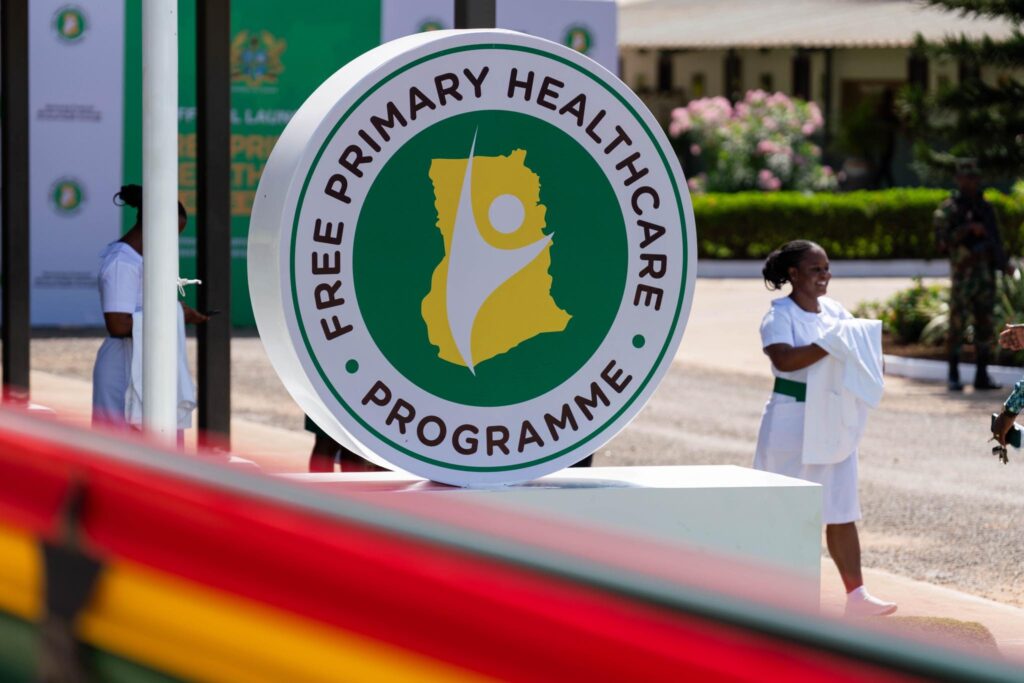
The government has officially rewritten the rules of health care delivery in Ghana. President John Dramani Mahama recently launched the nation’s flagship Free Primary Healthcare Policy at the Shia-Osudoku District Hospital, signalling a massive shift from treating illnesses to preventing them entirely.
This ambitious program targets Universal Health Coverage (UHC) by removing financial barriers for everyday citizens at the grassroots level. For years, the National Health Insurance Scheme (NHIS) has carried the heavy lifting of National Health financing. However, persistent gaps in rural areas and rising costs still keep many Ghanaians from seeking early medical attention.
The new policy directly addresses these shortfalls. Under the new directive, citizens can now walk into any designated primary facility, including local Community-based Health Planning and Services (CHPS) compounds, polyclinics and local health units and receive treatment for basic illnesses like malaria and cholera completely free of charge.
To bridge the gap in crowded urban zones and remote villages, the Ministry of Health is rolling out over 350 container-based health kioks. These kiosks place basic medical services directly where people gather every day in bustling markets and busy lorry parks.
The Government is actively partnering with traditional and religious leaders t encourage families to participate in routine checkups. “We want to catch illnesses before they become life-threatening. “President Mahama stated during the launch. By extending services to the grassroots level, we are moving the focus from purely curative care to preventive care.”
A policy this large requires heavy human resource backing. To meet the demand, the Ministry of Health has already deployed 24,534 pieces of essential medical equipment to upgrade local clinics. Simultaneously, the Ministry is aggressively expanding the healthcare workforce. Following the initial deployment of thousands of new professionals, the government has opened a specialised recruitment portal to fill critical vacancies in the northern regions and psychiatric hospitals. Furthermore, a new national volunteer initiative will soon send over 6,000 recent health graduates to ensure the program runs seamlessly.
The government is executing the rollout in phases. Phase One immediately targets 150 underserved and rural districts across the country. The Ministry of Health plans to scale up the infrastructure rapidly, aiming for a complete, nationwide rollout between 2027 and 2028. For the average Ghanaian, this policy promises a future where a simple checkup no longer depends on the size of their wallet.