









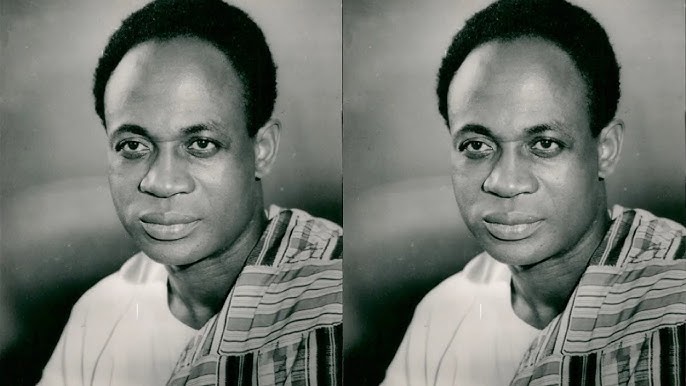
Kwame Nkrumah, born Francis Kwame Nkrumah on 21 September 1909 in Nkroful in the Gold Coast (now Ghana), remains one of Africa’s most significant political figures. Nkrumah was not only a politician but also a political theorist, revolutionary, and a global symbol of Pan-Africanism.
Early Life and Education
Raised by his mother, Elizabeth Nyanibah, after his father’s death, Nkrumah enjoyed an upbringing marked by communal values and a strong sense of belonging. He excelled academically at a Catholic elementary school in Half Assini, later progressing to the Government Training College at Achimota in Accra.
In 1935, Nkrumah travelled to the United States to study at Lincoln University and the University of Pennsylvania. His time abroad broadened his worldview: he earned degrees in economics, sociology, philosophy, theology, and education. Beyond academics, he became immersed in African nationalist movements, social activism, and Pan-African ideas. Nkrumah envisioned a liberated, united Africa.
He later moved to London, where he participated in the Fifth Pan-African Congress in 1945. The congress, attended by African leaders such as Jomo Kenyatta and Hastings Banda, was pivotal in shaping strategies for Africa’s decolonization. Nkrumah’s political ideology was anchored in socialism, anti-imperialism, and Pan-Africanism.
Political Rise in the Gold Coast
In 1947, Nkrumah returned to the Gold Coast and became general secretary of the United Gold Coast Convention (UGCC). Kwame Nkrumah’s populist appeal set him apart from the party’s more conservative leaders. He advocated “Self-Government Now,” galvanizing workers, farmers, students, and women. The 1948 Accra riots, which followed protests by ex-servicemen, highlighted the urgency of political change. Nkrumah, along with other leaders known as the “Big Six,” was arrested, further boosting his popularity.
By 1949, he broke away from the UGCC to form the Convention People’s Party (CPP). The CPP mobilized mass support through rallies, songs, and symbols like the red cockerel. In the 1951 elections—the first under universal franchise in colonial Africa—the CPP swept to victory even as Nkrumah campaigned from prison. Upon release, he was invited to form a government, becoming Leader of Government Business and later Prime Minister.
On 6 March 1957, the Gold Coast became Ghana, the first sub-Saharan African colony to gain independence. Nkrumah proclaimed, “At long last, the battle has ended! Ghana, your beloved country, is free forever.” As prime minister and later president (1960–1966), Nkrumah pursued ambitious policies. He championed education, industrialization, and infrastructure projects, including the construction of Tema Harbour and the Akosombo Dam.
He also established free and compulsory education, believing knowledge was central to nation-building. Internationally, Nkrumah was a vocal Pan-Africanist. He helped found the Organisation of African Unity (OAU) in 1963, advocating for continental unity as a path to political and economic strength.
Kwame Nkrumah and the Cold War
At the height of the Cold War, a period of intense rivalry between the United States and the Soviet Union, many newly independent African nations were pressured to choose sides. Whichever side they aligned with often meant potential economic punishment from the other.
Within this context, Nkrumah boldly charted an alternative course. He was one of the founders of the Non-Aligned Movement (NAM), a coalition of nations that refused to be pawns in the East–West struggle. Instead, NAM countries sought to prioritize independence, sovereignty, and development.
To capture this vision, Nkrumah famously declared: “We face neither East nor West; we face forward.” A call to Africans to focus on their own destiny, building prosperity and dignity for their people without foreign domination.
However, this position came at a cost. While non-alignment opened doors to aid and opportunities, it also fueled suspicion and foreign-backed plots.
Decline and Overthrow
By the mid-1960s, Ghana faced growing difficulties. Declining cocoa prices weakened the economy, while Nkrumah’s large-scale projects created mounting debt. Kwame Nkrumah declared a one-party state in 1964 alienating sections of the population.
On 24 February 1966, while Nkrumah was abroad on a peace mission to Vietnam, Ghana’s military staged a coup that abruptly ended his nine-year presidency. Though initially justified as a move against corruption and mismanagement, the coup’s swift alignment with Western powers revealed its deeper geopolitical motivations. Evidence later showed that Western intelligence networks, including the CIA and British operatives, had prior knowledge and links to the coup plotters.
Reactions at home were mixed. Some urban populations welcomed the change, but many rural communities that had benefited from Nkrumah’s development policies lamented his removal.
Kwame Nkrumah, now exiled in Guinea, was made honorary co-president by Ahmed Sékou Touré. He continued to write, speak, and advocate for Pan-African unity until his death in Bucharest, Romania, on 27 April 1972.
Legacy
Kwame Nkrumah’s legacy is complex. He is remembered as the Osagyefo (Redeemer), who inspired Africa’s independence struggles and articulated a bold vision of unity and self-determination. His policies laid the foundations for modern Ghana.
Above all, his life underscores the unfinished struggle for African liberation. In a world where powerful nations still jostle for influence, Nkrumah’s call to “face forward” rings louder than ever. For Africa, the real task remains clear: bringing prosperity to its people and ensuring they live dignified lives.
In 1999, the BBC named him “African of the Millennium,” a testament to his lasting influence. Kwame Nkrumah’s life illustrates the power of vision and determination in shaping history. He remains a towering figure, embodying both the triumphs and challenges of Africa’s journey toward freedom and self-rule.





, remains one of Africa’s...)